
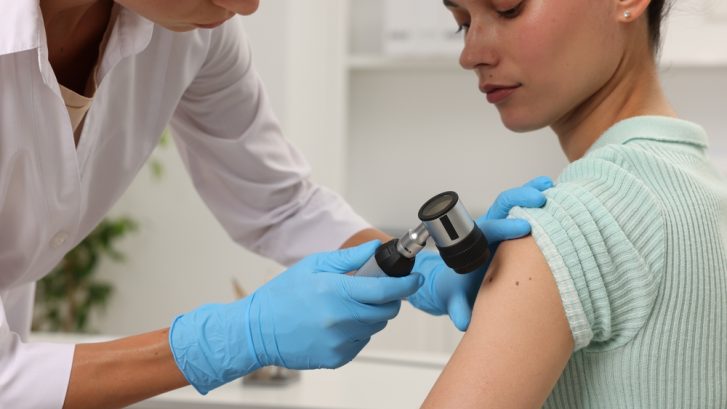
A mole that changes color, a bump that keeps bleeding, or a sore that seems to heal and then opens again is worth having checked. Skin cancer can take several forms, and some spots cause little or no discomfort. If you notice a new, unusual, or changing spot, call for an evaluation and describe what you’ve seen.
Mid-Atlantic Skin Surgery Institute evaluates suspicious moles and other skin lesions in Waldorf in Charles County and in Leonardtown and Lexington Park in St. Mary’s County. A visit can help you find out whether a spot needs monitoring, a biopsy, or treatment.
Skin Cancer Warning Signs Worth Checking
Pay attention to changes in spots you’ve had for years as well as new ones. A mole that stands out from the rest of your moles, sometimes called the ugly duckling sign, deserves a closer look. So does a spot that grows, develops persistent itching, bleeds repeatedly, or fails to heal. A shiny bump or a rough, crusted patch can also warrant an exam.
People of every skin tone can develop skin cancer. When looking over your skin, check areas that are easy to miss, including the scalp, back, palms, soles, between the toes, and around the nails. A mirror can help. Use the American Academy of Dermatology’s skin self-exam guide.
How to Spot Possible Melanoma With the ABCDE Guide
The ABCDE guide can help you recognize changes worth reporting during a mole check.
- A for asymmetry — One half of the spot looks different from the other.
- B for border — The outline looks uneven, scalloped, or poorly defined.
- C for color — The spot has several shades or an uneven distribution of color.
- D for diameter — Melanomas are often larger than 6 millimeters when diagnosed, about the width of a pencil eraser, but they can be smaller.
- E for evolving — The spot changes in size, shape, or color over time.
One warning sign is enough to call. Melanoma can develop in an existing mole or appear as a new spot. Some melanomas look pink or red, and a new or changing dark streak under a nail can also warrant evaluation. See the American Academy of Dermatology’s melanoma signs and symptoms.
Three Common Types of Skin Cancer
These three common skin cancers can overlap in appearance. A dermatologist considers the spot’s appearance, location, and history, and may recommend a biopsy to identify it.
Basal Cell Carcinoma
Basal cell carcinoma is the most common skin cancer. It may look like a shiny bump, a flat scar-like area, or a sore that repeatedly closes and reopens. It usually grows slowly and rarely spreads beyond where it starts. It can still grow into nearby tissue, which matters in areas such as the nose or around the eyes.
Squamous Cell Carcinoma
Cutaneous squamous cell carcinoma may look like a firm bump, a persistent scaly patch, or a crusted sore. It sometimes bleeds or becomes tender. Some squamous cell carcinomas can spread, and a weakened immune system can increase the risk of more aggressive disease.
Melanoma
Melanoma begins in melanocytes, the cells that make pigment. It is less common than basal cell and squamous cell carcinoma and more likely to spread if it goes untreated. If a biopsy confirms melanoma, the next steps depend on factors such as the tumor’s thickness and stage. Read more about melanoma evaluation and treatment and the CDC’s guide to skin cancer symptoms.
What Happens During a Skin Cancer Screening or Mole Check
When you book, say whether you have a specific spot you want examined or want to discuss a full skin exam. If you’ve noticed a change, describe when it began and whether the spot has grown, bled, or started to itch. A dated photo can help show the change. Go ahead and book even if you don’t have one.
At the visit, point out the spot that prompted your call. Mention any previous skin cancers, family history of melanoma, tanning bed use, and medications that suppress your immune system. Your provider can advise whether a full skin exam or ongoing follow-up makes sense for you.
If a spot looks suspicious, your dermatologist may recommend a biopsy. A lab examines the tissue under a microscope to determine what the spot is. Ask when you can expect results and how the office will contact you. If skin cancer is confirmed, treatment depends on the type, location, and other findings. The practice offers Mohs surgery and other skin cancer treatments, including superficial radiation therapy for select cases.
Frequently Asked Questions
Can a spot be skin cancer if it doesn’t hurt?
Yes. Some skin cancers cause no pain, especially early on. A persistent sore, changing mole, or growing bump deserves an exam even if it feels fine.
Does a suspicious mole always need to be removed?
Your dermatologist will decide whether monitoring or a biopsy is appropriate based on the exam. When melanoma is suspected, a biopsy is used to establish the diagnosis. Any further treatment depends on the pathology results.
How often should I have a full skin exam?
Ask your dermatologist what schedule fits your history and risk. The U.S. Preventive Services Task Force found insufficient evidence to recommend for or against routine visual screening for people without signs or symptoms. If you notice a concerning spot, call to have it evaluated promptly. Read the USPSTF skin cancer screening recommendation.
Schedule a Skin Exam in Southern Maryland
If a mole has changed or a spot keeps bleeding, growing, or reopening, call Mid-Atlantic Skin Surgery Institute and tell us what you’ve noticed. We’ll help you schedule an evaluation at a convenient office. At your visit, we’ll examine the area and explain whether monitoring, a biopsy, or another step makes sense.
- Waldorf (Charles County) — 301-396-3401
- Leonardtown (St. Mary’s County) — 301-475-8091
- Lexington Park (St. Mary’s County) — 240-237-8268
Contact Mid-Atlantic Skin Surgery Institute to schedule a skin exam.